Friday, July 31, 2015

James Ryker, died 1801; Elizabeth Ryker, died 1814: Davis Family Cemetery, Greenwich


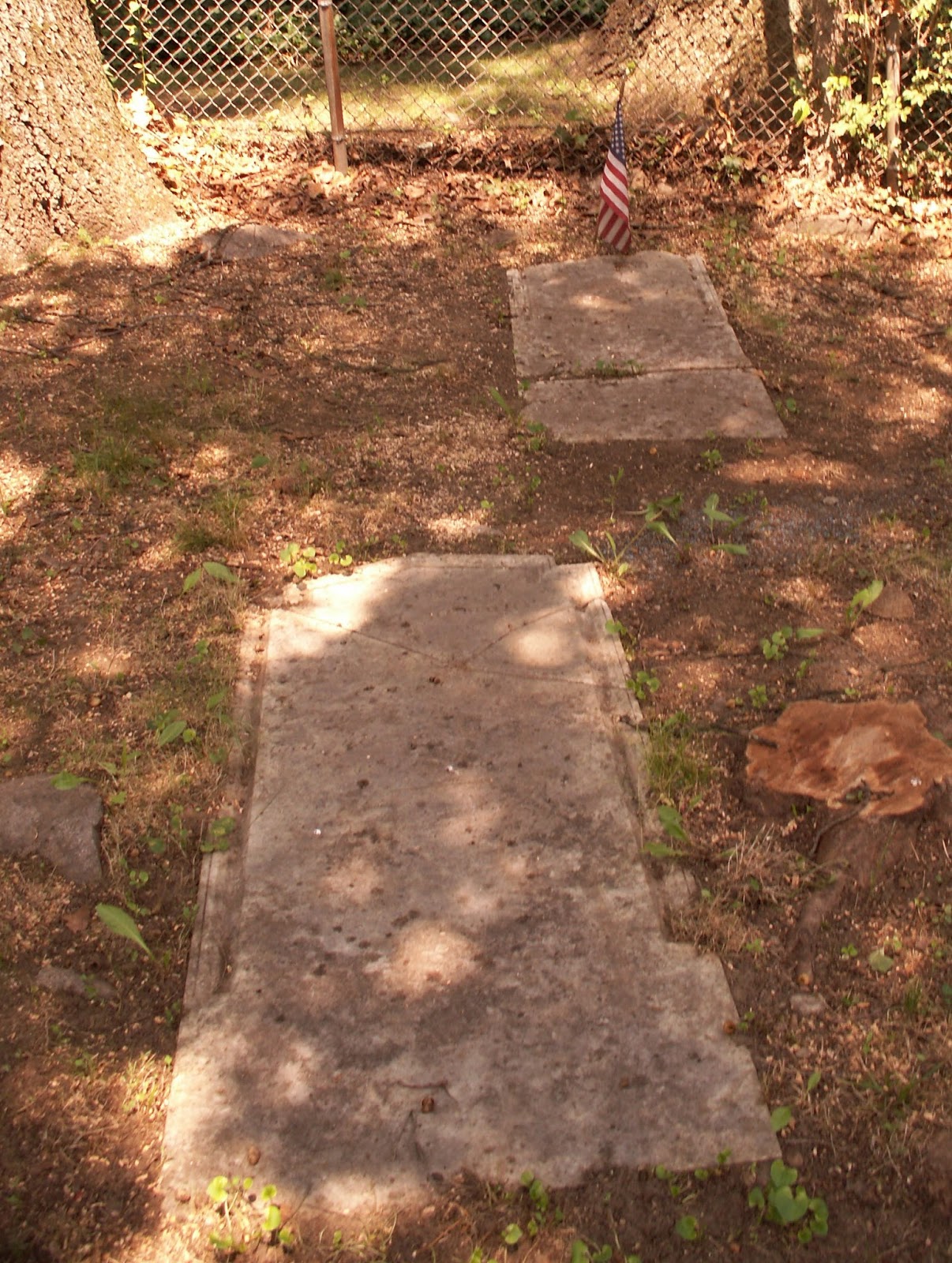
Located at the end of East Bruce Park Avenue in central  Greenwich, the Davis Family Cemetery is a small historic plot. It is surround by a chain-link fence and shaded by tall trees. 

The tombstones are carved out of brownstone and marble with each stone lying flat on the ground. 
This family once owned a very old grist mill which was built circa 1705 and demolished in 1889. The mill was located at the west entrance to Bruce Park. The millstones are displayed near this site. Davis Avenue was the road leading to this area, once known as Davis Landing.
Thomas Davis came to Greenwich in 1761 from Oyster Bay, Long Island and purchased the mill. He died around 1780, his plot is unmarked in the cemetery. During the Revolution his sons, Elisha and Stephen, operated the mill. Elisha was caught selling grain to the British. His 50% interest in the mill was confiscated and acquired by Stephen, whose sympathies were with the American patriots. Stephen died in 1797 and is buried in an unmarked plot. Elisha eventually returned to Greenwich and died in 1818, aged 76 years. His stone was removed or stolen years ago.
Esther, the daughter of Elisha Davis, married John Ryker of New York. It is on the marble tombstones for the Rykers that the epitaphs are inscribed. The last burial to take place here was in 1862.


James Ryker,
died December 15, 1801, aged 17 days.
Elizabeth Ryker, died October 28, 1814, aged 8 months, 5 days.

Happy the babes, who privileged by fate
To shorter labor and a lighter weight
Receiv'd but yesterday the gift of breath

Or'd to-marrow to return to death.

Thursday, July 30, 2015

Betsey Sherwood, died 1875: Old Baptist Society Cemetery, Glenville

Welcome to the Old Baptist Society Cemetery! This site is located off Glen Ridge Road in the Glenville neighborhood of the Town of Greenwich.

This attractive cemetery contains the remains and gravestones of many of the original Baptists of the Town of Greenwich and their descendants. They were also among the first to settle in the village of Glenville. 
The original church edifice itself was situated adjacent to the neighboring Merritt plot. The church was used as a hospital during the Revolution to treat wounded soldiers. 

The King Street Baptist Society Church was formally gathered on November 3, 1773. The meetinghouse itself was considered one of the most attractive in Greenwich. Services ceased to be conducted in 1886 and the church building burned to the ground on October 25, 1899. 

The Baptist parsonage still stands off King Street just south of the King Street Baptist Society Cemetery and the Anderson plot. The cemetery is well maintained and worthy of a visit by those interested in peering into the early history of Glenville and its Baptist settlers.

Featured here is an image of the gravestone of Betsey Sherwood and her epitaph. 


Betsey Sherwood,
died January 11, 1875. 
Aged 84 years, 10 months & 14 days.

The years roll round and steals away
The breath that first it gave
Whate'er we do, where'er we be
We're traveling to the grave.


Sunday, July 5, 2015

Timothy Wilcox, died 1863 North Greenwich Congregational Church Cemetery

Known commonly as The Church at the Crossroads, the North Greenwich Congregational Church is located at the intersection of Riversville Road and John Street.  In the spring of 1833 Reverend Chauncey Wilcox and church sexton William Lounsbury laid out the cemetery for family plots. These plots were provided free of charge to members of the church, a policy that still survives today.
A number of families associated with the history of this church and North Greenwich are interred here. These include such family names as Brown, Close, Husted, Kenworthy, Mead, Lounsbury, Peck, Mills, Tripp, Purdy, and others. Eight of the original founders  of the church are interred here. According to church records there are 13 Civil War veterans and 3 from World War I interred here.
Without doubt the most famous person buried here is the Reverend Chauncey Wilcox, the first minister of the Church. He served the congregation from 1828-1846. His salary was $500 for the first year. Reverend Wilcox was a popular pastor with the people of the community. His efforts in starting the North Greenwich Academy was one of his works, which was found by him in 1834, where he worked as its first teacher. 

Rev. Wilcox was a strong believer in the missionary movement, and encouraged some parishioners to travel to the islands of Hawaii to convert the inhabitants to Christianity and engage in their education.  One of his parishioners, Charlotte Close, was the step-mother of Sanford Dole, first President of the Republic of Hawaii and eventually its first governor as an American territory in 1900. 

In commemoration of the 350th year celebrations of the founding of Greenwich in 1640 his imposing tombstone was refurbished and rededicated by Reverend Wilcox's great-grand niece Elizabeth Willis in 1990.
The Wilcox family were very active in the early years of the church and many are interred in the cemetery. Willis Wilcox was a Civil War veteran. Josiah Wilcox was a self-made businessman who built a factory off Sherwood Avenue which produced, amongst other things, cannon balls for the war effort. Josiah was also a one term member of the Connecticut legislature. His mansion, built circa 1838, is located just north of the Merritt Parkway. It is listed on the National Register of Historic Places.
The epitaphs at this cemetery are Biblical quotes with a few original works. 

Besides the epitaph for Rev. Wilcox others worthy of note include that of his son Timothy, who followed in his fathers' steps but died young at the age of 27 years and 9 months in 1863 at Chicago, Illinois. The image of his stone and the above-ground text of his epitaph is reproduced here. 

The cemetery is still in use today by the church and makes a tranquil spot to visit in one of the most historic areas of the Town of Greenwich. 


Timothy K. Wilcox, 
son of Reverend Chauncey & Sarah A. Wilcox,
died February 27, 1863.
died suddenly at Chicago, Ill. 
Aged 27 years & 9 months.

As a son, brother, friend he has left an
aching void: as a scholar he wore
mostly the first honors of his class
at Yale & became Tutor at his alma mater
as a citizen his energies & substance
were ever ready for every benevolent
& Christian cause: as a minister of the
Gospel he reaped during his brief labors
rare success & personal affection.
He drew so largely from the living Fountain
that every relation with rich.....

Saturday, February 21, 2015

The Judge's Corner: The Proprietors of the New Burial Ground In Greenwich Hold 99th Annual Meeting


The Judge's Corner: "The Proprietors of the New Burial Ground in Greenwich" Hold Their 99th Annual Meeting-The History of the Cemetery Adjoining the Second Congregational Church.
Greenwich New and Graphic, 1932. 
By Frederick A. Hubbard

#210

Recently "The Proprietors of the New Burial Ground in Greenwich" held its annual meeting. It sounds new but it is scarcely that, as this was the 99th annual meeting. And yet perhaps after a few more centuries have been checked off those then in being may look back upon it as now the days of its infancy.

It lies just west of the Second Congregational Church and by many is considered as the cemetery of that church. But it is as separate from that institution as is Putnam Cemetery. Created by an act of the general assembly an 1833, it sold lots without regard to ecclesiastical denomination. Unlike many pieces of Greenwich real estate it can boast of no long string of individual owners.

In 1697 it was included in the patent of the Colonial General Court and the leading patentee was Angell Husted. His name stands at the head of the list. He was a resident of Greenwich, old town. The nickname of Horseneck did not appear 'till after the ecclesiastical division in 1705. But it was a significant fact that when he acquired what is now the cemetery and other land he had picked one of the choicest house lots on the "Westchester path."

The old Second Congregational Church (right) before the establishment of the New Burial Grounds Association.
By Mary Mason. 

He knew where the meeting house was to be located and possibly that fact had an influence on his selection. To go to meeting required no equestrian transportation. Here town meetings and religious services will be held and a saddle for himself and a pillion for his wife were not necessary. In these days it would be termed a convenient location. And here Angell Husted located his farm house and building with many acres extending north.

*****************

Angell Husted was a leading man in the new settlement. His name appears frequently in the public records. He was one of the first 52 taxpayers. He bought and sold land. Town meetings appointed him to positions of trust. He and two brothers and 1715 laid out the site for the grist mill and the road along the north side of Horseneck brook, just south of the Greencourt Inn. But our interest is in his homestead on the hill. It is easy to imagine how it looked with its leanto in the rear, its graceful front porch and the stone horse block from which he mounted his horse. The well sweep and the oaken bucket must have been near the back door located at what is now the center of the cemetery.

*****************

A feature of the old place was the stone wall in front, laid up dry, and the wall is still standing. The records of the cemetery show that the parcel was enclosed on all sides by stonewalls. It was voted to remove the one on the east side "next to the meeting house yard" and to rebuild the ones on the north and west sides, "adjoining Miss Cornelia Graham's garden." But no mention was made of the stone wall in front except to the east and west stone gate posts, from which certain measurements were made and it was voted to procure an iron gate with "oval-top" which gate is still in use.

The gate to the New Burial Grounds Association Cemetery. Image July, 2014. 

This gate has been examined by William Gasparrini of the Post Road Ironworks on the top of Tollgate hill.

And in fact the iron worker's shop stands on the identical spot occupied by the Tollgate house which was removed in 1899. Mr. Gasparrini says that the gate of wrought iron was probably made by the village smithy. And he adds, "Keep it painted and it is good for more centuries to come."

It is safe, therefore, to say that the front fence is more than 200 years old. Pioneers built stone fences. Angell Husted was not a young man when he moved to Horseneck but he was not beyond the fence building age. And besides he had husky sons, and in those days everybody, including father, worked.

*****************

The old record book of this corporation is itself a curiosity. Mahlon Day of 876 Pearl Street sold the book. He also carried a stock of quills and it is probable that all of the first few pages of the record books were written with a quill pen, for steel pens were not in common use until the middle of the 19th century. The chirography is clear and distinct, the words being well apart and the letters carefully formed. The act of incorporation occupies two and one-half pages and has a copy of the seal of the state and the signature of Thomas Day, its secretary. But the paper is course and unglazed and the ready absorption of the ink accounts for the unfaded pages.

The Second Congregational Church of Greenwich, Connecticut as seen from the cemetery. 

*****************

All authorities agree that at the close of the Revolutionary war Angell Husted's homestead occupied what is now the cemetery plot. Between that time and 1833 – over 50 years – a later built house may have stood on the same site, but that is not probable. The purchase price of $500 paid to Soloman Mead shows that no buildings were then on the premises.

And it is not unlikely that Mr. Mead had filled the old cellar hole and cultivated land for a number of years before he sold it. The record shows that $440 was paid to Church & Henderson for improvements, which without doubt included the restoration of the stone walls mentioned above. We have never seen any other mention of this firm of contractors. Their work has outlived their memories.

*****************

The organization of this cemetery 99 years ago was a great event, for all the prominent people of the town were interested in it. And they individually signed the old record book. Some of the names have been handed down through succeeding generations.

It may be of interest to give them in the order of their signing as follows: Isaac Mead, Esbon Husted, Nehemiah Howe, Isaac Holly, Ebenezer Mead, Rachel Mead, Alma Mead, Elizabeth Knapp, Jonathan Mead, Samuel Peck, John Packett, Amy Mead, Ephm Marshall, Jabez Mead, Azra Banks, Zopher Mead, Stepen Waring, Jane S. Waring, Gilbert P. Finch, William A. Husted, Ephriam Lane, Thomas Funston, William Funston, Charles Smith, Augustus Mead, Drake Husted, Robert Clark, Augustus Lyon, Caleb Holmes, Lewis Lyon, Allen R. Knapp.

*****************

The act of incorporation, said to have been prepared by that eminent lawyer, Charles Hawley, includes many details and created some laws that never could have been enforced. It specifies that the "first meeting of the proprietors" shall be held at the Inn of Augustus Lyon on the first Monday of July, 1833, with Darius Mead, Jr., in the chair and Allan Mead recording.

This meeting was adjourned to the house of Alvan Mead on Sept. 2, 1833, when it was voted to accept the charter. Jonas Mead was elected moderator, Dr. Mead apparently being absent and Jonas Mead chosen moderator in his place. Sanford Mead was elected collector. The act of incorporation gave authority to tax the lot owners each year for the maintenance at the cemetery.

In one instance $200 was voted to be charged proportionately against them but the collection of the tax was not easily accomplished. This duty finally devolved upon the secretary, Alvan Mead, who held that office until his death in 1883. The lots were priced at $28 each and Darius Mead, Jr., Zaccheus Mead and Alvan Mead were appointed a committee of sale and at the same meeting it was voted: 

"that the money arising from the sales shall be paid to the treasurer shall be applied to the payment of the debt now standing against the company and to the payment of such expenses as may be necessary to complete the burial ground, and the remainder should be paid in equal sums to the following person, viz., Shadrach Mead, Jonas Mead, Daniel Merritt, Darius Mead, Jr., Alvan Mead, Thomas A. Mead, Sanford Mead, Zaccheus Mead, Jr., Solomon Mead and Edward Mead, their heirs and assigns as an indemnification to them for expenses incurred by them in the purchase and preparation of the burial ground." 

This shows who were the creditors and how they had loyally advanced money out of their own resources. It was probably several years before a sufficient number of lots were sold to reimburse the promoters.

*****************

For more than 40 years the cemetery has been maintained by voluntary subscriptions. Some of the plots have been provided with a fund for perpetual care. The question has sometimes been raised as to whether the cemetery will not before many years be discontinued. An attempt was once made to throw it into the discard by the passage of a special act of the general assembly that no burials could be made in the Borough of Greenwich after July 1, 1884. Any attempt that may of been made to enforce the law utterly failed because of its legally created inception and the vested rights of plot owners.

The cemetery is as permanent as Trinity or St. Paul's of New York or the old granary burial ground on Tremont St., Boston. Like that cemetery, visited daily by people from all parts of the world, our cemetery is a point of interest attractive to many visitors. The headstones reveal the names of those sturdy old pioneers who had the responsibility of molding the character of their children and in shaping the progress of this old New England town. The cemetery is governed by six managers with Oliver D. Mead, president.

Frederick a Hubbard.


Cemeteries Offer History Lessons (Greenwich Time, 1992)

Greenwich Time, Greenwich, Connecticut
October 30, 1992. Page 1, Column 1
by Thomas Mellena, Special Correspondent

Tomac Cemetery, Old Greenwich. August, 2014

Brown and yellow leaves lie like a thick carpet at the foot of Nathaniel Lockwood's tombstone.

It has few companions back here, few stones reach up out of the undergrowth and leaves. Some have been stolen over the years. Others, having fallen over a long time ago, lie under overgrown sod, buried as are the people whose graves they marked.

This is the deepest part of Tomac Cemetery, Greenwich's oldest burial ground.

Brownstone markers in the cemetery identify Greenwich residents who died during the Revolutionary War. Other markers, nondescript stones and rocks that were pulled from the woods, are too faded to read. Near the front of the cemetery, closer to Tomac Avenue, 19th century stones are made of marble. They are arranged in rows, surrounded by manicured grass.

Gravestone of Nathaniel Lockwood, Tomac Cemetery. August, 2014. 

Stones throughout the graveyard are engraved with names like Mead, Peck, Ferris and Lockwood.

To horror movie aficionados and those with overactive Halloween imaginations, graveyards – with their promise of zombies ready to climb out of the ground – represent the ultimate no man's land.

To the less superstitious history buff, they are a direct connection to the past.

There are at least 65 burial grounds in Greenwich, ranging from multiple-acre cemeteries to three-or-four-grave family plots. Many provide the first step to unlocking stories of the town's past.

"The overwhelming number of family grave plots used to be part of the large farms that used to exist in town," said Jeffrey Bingham Mead, historian and chairman of the Burying Grounds Committee of the Historical Society of the Town of Greenwich.

Mead became interested in cemeteries in 1984 when cleaning up one of the several Mead family plots in town for a relative. He started a family association to care for all the Mead plots in town.

Mead this month presented to the public a series of slide shows and walking tours of Greenwich graveyards. The six-part series was attended by about 20 people, Mead said.

Something as simple as the symbol carved in an 18th century tombstone or an epitaph engraved in the 19th century stone can say much about how life was lived at the time, Mead said.

Puritan residents in the 1700s lived in a world without modern medicine, where women often died during childbirth, where a minor drought could spell disaster to a family, where sweeping epidemics and the children dying during infancy where the norm.

The pessimism bred from enduring such hardships is reflected on many Puritan tombstones, like that of 30-year-old Simon Redfield, who was buried in 1823 in the Anderson Family Burial Ground on King Street.

"Farewell my young companions all/In the dust you soon must be/Be wise and oh remember this/That you are bound to die."

The gravestone of Nathaniel Lockwood, Tomac Cemetery, Old Greenwich. 

Two stones in Tomac Cemetery near Nathaniel Lockwood's were decorated with the death-head – a winged skull – a common symbol used by the Puritans to remind the visitor of the inevitability of death.

Time passed and some families began to acquire land, wealth and a sense of permanence. Some of the pessimism began to fade.

The death head was replaced by crowned winged soul effigies – a face instead of skull, with wings to symbolize the resurrection and a crown to show entrance to the kingdom of heaven.

Later in the century, symbols from nature, such as the weeping willow trees, became more popular.

The gravestone of Charity Mead, wife of Joshua Knapp, is adorned with weeping willow trees.
The stone is in the Knapp Family Burying Ground at the corner of Round Hill Road and Sumner Road.
Image: October, 2014. 

"You get the impression from the 19th century stones that death was a source of release and comfort," Mead said. "But with the Puritans it was, 'Like it or not, you're going to die, and it's cold and dark here.' Something from the Stephen King movie."

Epitaphs and symbols have mostly become a thing of the past, Mead said, because of the price of stone-carving today. To have a stone decorated like many in the town's older cemeteries could cost as much is $15,000 today, he said.

Which spells bad news for future historians, because it's usually the epitaph that spurs people like Mead to research a name found on a tombstone.

The epitaph on the gravestone of Benjamin Mead III in the Mead Burying Ground at North Greenwich off
Cliffdale Road. 


"There are those sparks," he said. "It might be, for example, that someone died in battle. I'll see that and say, 'Wow this is really interesting, and go from there."

Searches often lead to the records vault at Town Hall, obituaries in old newspapers and the many written and oral histories of town. Sometimes though, searches end abruptly.

The gravestone of Garret Schloter, Old Burying Ground at Clapboard Ridge. October, 2014. 

Like the search for Garrett Schloter, whose tall brownstone marker in the Old Burying Ground at Clapboard Ridge, on Butternut Hollow Road, is decorated with a winged soul effigy – the only stone decorated as such in the cemetery.

"The only other places that symbol is found is in Tomac and Cos Cob (the Old Burying Ground at Cos Cob on Strickland Road)," Mead said. There is no record of Schloter owning any land or living anywhere in town.

"He's in none of the histories," Mead said. "Yet he has a very large stone, much larger than any other there. It's like, 'Well, who was this man?' "

Often, Mead find members of his own family in the graveyards.

"I can't put it in words really," he said of, for example, discovering the grave of an ancestor who served in the Revolutionary War. "But I've read about these people and have heard about them from the old folks. It's a sense of discovery. And a sense of completeness too."

With tough economic times, he said the burden of caring for smaller cemeteries should be taking care of taken off the town – which does maintain many – and picked up by families or churches. Many have responded to his requests, he said, but about 20 percent of town burial grounds remain in need of care.

The other problems facing graveyards are theft and vandalism, Mead said. Before laws were passed in the early 1970s that imposed strict penalties for stealing tombstones, theft of New England stones for sale in New York antique stores was a major problem. The two deaths-head stones near Nathaniel Lockwood in the Tomac Cemetery were stolen in 1972. One was returned anonymously to the Historical Society.

Vandalism remains a larger problem. Last December, at least 24 headstones from the 19th century were smashed or toppled at the cemetery of the first Congregational Church in Old Greenwich.

"I'd like to ask people in town that, if they see any suspicious behavior, to please call the police," Mead said.


Town's Past Entombed in Cemeteries (Greenwich Time, 1992)

Greenwich Time, Greenwich, Connecticut
by Thomas Mellana, Special Correspondent
September 25, 1992, Page 1

The gravestone of Sarah Gardner, Cos Cob. Died 1795. 

"I found an enormous amount of history there."

Greenwich residents who died in years past were fond of leaving reminders to the living that we are all in the same boat.

Behind and think as you pass by
as you are now so once was I
As I am now so you must be
Prepare to die and follow me.

That was the message left to the world by Sarah Gardner, who died Oct. 24, 1795, at the age of 21 years, 7 months and 7 days. Sarah was interred in the Old Burying Ground at Cos Cob.

Lockwood Palmer, who died Aug. 25, 1819, at 21 years and 8 months, is buried in the Cherry Orchard Cemetery, in the woods off Stanwich Road. He left this message for loved ones:

Dear friends who live to mourn and weep
Behold the grave wherein I sleep,
Prepare for death for you must die
And be entomb'd as well as I.

Of course, many epitaphs are more cheerful. But more than a few tombstones in town leave one message that is very clear: You're next.

"Especially the old Puritan ones were like that," said Jeffrey Bingham Mead, who has researched local graveyards. "Epitaphs do reflect a lot about about the attitudes of the times, and in Puritan times, life was not as good as it is today."

An examination of epitaphs will be part of a series of slide/lecture shows and walking tours during October and November to educate residents about a sometimes forgotten part of Greenwich's past.

"The Spirit of Greenwich Old Time Past: The Burying Grounds of Greenwich Connecticut," will be led by Mead, historian and president of the Historic Mead Family Burying Grounds Association, Inc. Mead will lead three slide/lecture shows and three walking tours.

There are about 65 burying grounds scattered throughout town, according to Mead, some so small they contain fewer than 10 graves.

Mead, a descendent of one of the founding families of Greenwich, backed into his interest in burial grounds in 1984 when cleaning up one of the many Mead family plots in town for a grand aunt.

"I found an enormous amount of history there," he said.

Students can expect to leave the lectures and tours with "an enhanced appreciation of the history of the town of Greenwich," said Mead. "It's not only old houses and great estates, which are very important, but there is a lot more."

"Examples of poetry, and the earliest examples of folk art and sculpture in Greenwich can be found in its old burial grounds."

Topics for the slide and lecture shows are:

- The Community Burying Grounds of Greenwich, Oct. 6.

- In Search of Graven and Rhymes and Epitaphs, Oct. 13.

- Death-heads, Willows and Angels: Mortality Art on the Gravestones in Greenwich, Oct. 20

All lectures will be held 7:30 p.m., in the meeting room of the Arts Center on Greenwich Avenue.

The on-site tours scheduled are:

- Tomac Cemetery: a Hallowed Walking Tour, Tomac and Roosevelt avenues in Old Greenwich, Oct. 18 at 2:30 p.m.

- The Lewis Family Burying Ground: A Sacred Family Album, off Lafayette Place in central Greenwich, Oct. 25 at 2:30 p.m.

"There is a lot to be learned about geneaology," in the old graveyards, Mead said. "That Lewis one is definitely one of the top five most interesting family plots, if not the most interesting, I know. There is an enormous amount of town history there."

- The New Burial Grounds Association Cemetery, East Putnam Avenue next to the Second Congregational Church, Nov. 1 at 2:30 p.m.

Cost of attending the entire program is $55. For three lectures or three tours, the cost is $30. Each individual tour or lecture will cost $10.




Friday, February 20, 2015

Michael Clear, U.S. Navy: Old Burying Ground at Byram Shore (1858)


One of the names of those interred at the Old Burying Ground at Byram Shore is Captain Michael Clear. He was a native of Queen Anne's County, Maryland. 

Michael Clear served as captain of the foretop on board the U.S.S. Constitution -popularly known as Old Ironsides- in the Barbary War and the War of 1812. 


The U.S. Constitution in Boston Harbor, Massachusetts. 

In 1810 he had been a sailor before the mast. He reportedly aided at taking the British frigate Guerriere under Commodore Hull, at taking the British frigate Java under Commodore Bainbridge, and taking the Cyane and Levant under Commodore Stewart.

Later, he returned to the Merchant Marine and then returned to service on the Sloop of War Erie. Afterward, Clear served on the Congress. His final position was that of Sailing Master at the Brooklyn Navy Yard in New York. 

Relics of his were reportedly given by his descendants to the Bruce Museum in Greenwich in the 1930s. These items included an old sextant and Captain Clear's name inlaid on ivory, his commission signed by President Tyler, a compass and spy glass, and a collection of old almanacs from 1825-1858. 

Captain Clear died on March 28, 1858 at the age of 75 years. 

The following are transcripts of three published articles in the Greenwich News and Graphic. 


* * * * * * * * * 

Constitution Relics Are Given To Bruce Museum by Miss Weed
Greenwich News and Graphic
Thursday, November 4, 1937

The Bruce Museum of Greenwich is the fortunate recipient of a number of instruments and personal possessions of the late Capt. Michael Clear, U.S.N., which were used by him when he served as captain of the foretop on board the United States Ship Constitution, the famous “Old Ironsides" of the Barberry War and the War of 1812. Miss Weed is the grandniece of Captain Clear, and it is with great pride that the museum announces her wonderful gift.

The collection includes, in its original box, the old and beautifully fashioned sextant, with the captain's name inlaid on ivory, made by E. and G.W. Blunt, hydrographers and instrument makers, formerly Maiden Lane, New York City; the compass and spyglass made by Jones of Liverpool, and th captain's commission signed by President Tyler.

Michael Clear was a native of Queen Anne's County, Maryland. In 1810 he was a sailor before the mast, but in two years was commissioned by President Tyler. He aided at the taking of the British frigate Guerriere under Commodore Hull; at the taking of the British frigate Java under Commodore Bainbridge, and at the taking of the Cyane and Levant under Commodore Stewart.

Captain Clear subsequently returned to the merchant marine, and after a number of years again entered the service on the sloop-of-war Erie. Later he served on the Congress, and his final position was that of a sailing master at the Brooklyn Navy Yard. He died in Greenwich on March 28, 1858.

Looking upon these relics one imagines the sights which must have come to the captain's eyes through that old brass spyglass.

In addition to these things Miss Weed has donated the original brass buttons from Captain Clear's uniform, the sewing palm and needle which he used when before the mast, his notebook containing meteorological observations, seven letters and almanacs (The Farmer's and Middlebrook's) bound in sailcloth and running from 1825 to 1850.

These Constitution relics may be seen in a case on the first floor of The Bruce Museum.

In the War Alcove on the third floor may be seen the Civil War pass of Edwin A. Weed, also donated by Miss Weed.


* * * * * * * * * 


Old Almanacs Tell of Life in The Period from 1825 to 1859 (excerpt)
Once property of Capt. Michael Clear, Greenwich Mariner Who Served on the Old U.S.S. Constitution
Greenwich News and Graphic
Thursday, November 4, 1937

A canvas-bound collection of almanacs, formerly the property of the late Capt. Michael Clear and complete from 1825 to 1859, are in the possession of his great-nieces, the Misses Emily Stuart and Addie M. Weed of Weed Place. Captain Clear served both in the navy and in the merchant marine and at one time was on the old U.S.S. Constitution. 

Although the pages are well thumbed and show evidence of considerable use, the almanacs are in excellent condition despite their years. They contain all kinds of information from "necessary hints for those that would be rich" to "the rising, setting, places, and eclipses of the sun and moon," to say nothing about stories that would put Bayard Taylor's best decidedly in the shade.


* * * * * * * * * 


More Interesting Relics Are Presented to Bruce Museum (excerpt)
Greenwich News and Graphic
Thursday, November 24, 1937

Miss Adelaide M. Weed of Weed Place, Greenwich, who recently donated to The Bruce Museum, Greenwich, many relics of "Old Ironsides," has now given additional material, also of much interest.

Chief along these gifts is a stein used by Captain Michael Clear of "Old Ironsides" fame. The top of the stein, which he brought from Europe during the early 1800's, bears in pewter the heads of three kings or emperors-Franz, Alexander and Friedrich-and is dated 1824.